The Ultimate Guide to Audi Code Reader in the UK
An Audi code reader is a diagnostic tool that plugs into your Audi’s OBD port to read and clear fault codes, check why warning lights are on, and, with the right model, access Audi-specific systems such as ABS, airbags, service resets, EPB functions and DPF regeneration. For most UK drivers, a dedicated VAG-compatible scanner is far more useful than a basic generic OBD2 reader.
TL;DR: If you want to find out why your Audi engine management light, airbag light or ABS light is on, a proper Audi code reader can save you dealer diagnostic fees and help you spot faults before they become expensive. Based on our testing of VAG-focused diagnostic tools, generic OBD2 readers are fine for basic engine faults, but they usually miss Audi-specific modules and service functions that matter for UK ownership and MOT preparation.
That sudden flash of yellow on your dashboard. You are cruising down the M1, the engine sounds perfectly normal, but the Engine Management Light (EML) has just illuminated. For Audi drivers across the UK, this single dashboard icon instantly triggers a mental calculation of dealership diagnostic fees, off-road time, and the looming anxiety of the next MOT. However, handing over your keys to a main dealer just to find out what is wrong is no longer your only option.
The modern Audi is a marvel of German engineering, governed by a complex network of computers communicating thousands of times per second. When something falls out of parameter, the vehicle logs a fault code. Accessing this data used to require proprietary garage equipment costing thousands of pounds. Today, an Audi code reader places that diagnostic capability directly into your glovebox.
In this guide, we explain what an Audi code reader does, whether a generic scanner is enough, which features matter most, and how fault-code access helps with UK servicing and MOT readiness. In addition, we cover VAG-specific functions such as electronic parking brake resets, battery registration and diesel particulate filter (DPF) regeneration.
Key Takeaways
- Dealer Fees vs DIY: UK main dealers often charge around £100-£150 per hour simply for diagnostic time, so an Audi code reader can pay for itself quickly.
- Generic vs VAG-Specific: Standard OBD2 scanners usually only read generic engine emissions codes, whereas a dedicated VAG reader can access ABS, airbags, transmission and body modules.
- MOT Compliance: According to current DVSA MOT inspection rules, certain warning lights, including engine management and airbag faults, can lead to a major defect and MOT failure.
- Advanced Maintenance: Better Audi code readers can support EPB retraction, battery registration, service resets and DPF regeneration.
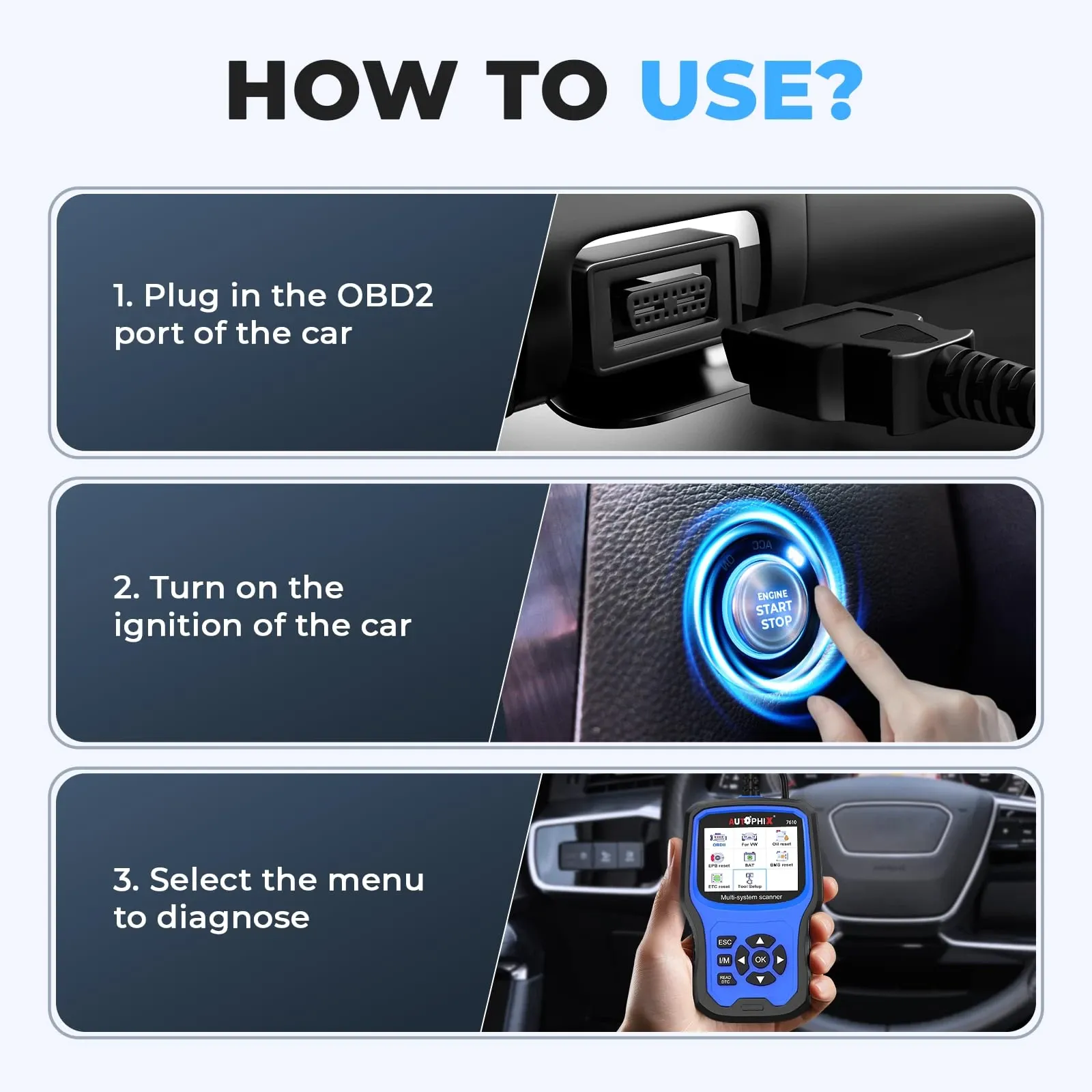
- Top Recommendation: For owners who want dedicated VAG diagnostics, the AUTOPHIX 7610 is a strong option for VW, Audi, Skoda and SEAT vehicles.
What is an Audi code reader?
An Audi code reader is a handheld scanner or app-based diagnostic tool designed to communicate with your Audi through the 16-pin OBD port, usually found in the driver’s footwell. It reads fault codes stored by the car’s control modules and helps identify the cause of warning lights, poor running, limp mode or service issues.
Since 2001 for petrol vehicles and 2004 for diesels, UK and EU regulations have required compatible vehicles to support EOBD diagnostics for emissions-related faults. As a result, even cheap scanners can read some standardised powertrain codes. However, Audi vehicles also use manufacturer-specific VAG systems and protocols, including K-Line, CAN bus and UDS, for many non-engine functions.
Therefore, while a universal reader may tell you why the engine light is on, a proper Audi code reader can also interrogate systems such as the gearbox, ABS, airbag, parking brake and instrument cluster. For a deeper explanation of the difference, read our guide to OBD2 scanners for VW and Audi.
What does an Audi code reader do?
A good Audi code reader does much more than display fault numbers. It can identify stored, pending and permanent trouble codes, show live data, clear faults after repairs, and access Audi-specific modules that a basic scanner cannot reach.
Based on our testing of VAG diagnostic tools used on UK-spec vehicles, the most useful real-world functions include:
- Reading and clearing engine fault codes
- Checking ABS and airbag warning lights
- Accessing transmission and DSG/S tronic fault data
- Resetting service lights and oil intervals
- Retracting the electronic parking brake for rear brake work
- Supporting battery registration on compatible models
- Starting DPF regeneration and checking soot load on diesel models
- Viewing live sensor data to help confirm faults before replacing parts
In short, it helps you move from guessing to diagnosing properly.
Is a generic OBD2 scanner enough for an Audi?
Usually, no. A generic OBD2 scanner is only enough if you want very basic engine emissions information. It can be useful for reading universal powertrain fault codes, but it will not give full coverage of an Audi’s systems.
Many British motorists buy a low-cost Bluetooth dongle and assume they now have dealer-level diagnostics. However, generic OBD2 was designed as a minimum legal emissions standard, not a complete vehicle diagnostic system. Consequently, it typically only communicates with the engine ECU.
A modern Audi A4, Q5 or A6 can have dozens of separate control modules. A generic scanner usually cannot access:
- Transmission Control Module: useful for diagnosing DSG or S tronic faults
- ABS/ESC module: for wheel speed sensor and braking system issues
- Airbag/SRS module: essential when the airbag light is on
- Body and comfort modules: for central locking, windows and HVAC issues
- Instrument cluster and service functions: for service resets and maintenance reminders
If you are trying to diagnose an electrical issue, gearbox warning, parking brake fault or airbag light, a generic reader can easily return “No Codes Found” even when the fault is real. So, for Audi ownership, a dedicated Audi code reader is usually the better choice.
Can an Audi code reader read ABS, airbag and service faults?
Yes, but only if it is a VAG-compatible or Audi-specific tool. This is one of the main reasons owners upgrade from a generic scanner.
According to UK MOT rules, warning lights for safety-critical systems can cause a test failure. Therefore, being able to read ABS and airbag codes before your MOT is especially useful. Likewise, service reset functions help after routine maintenance, while access to brake and battery procedures can save a separate trip to the garage.
Before buying, check whether the tool supports:
- ABS fault code reading and clearing
- Airbag/SRS diagnostics
- Service interval reset
- EPB brake pad replacement mode
- Battery replacement registration
- DPF diagnostics and regeneration
Why do UK Audi owners use a code reader before an MOT?
UK Audi owners often use a code reader before an MOT to identify dashboard warning lights and stored faults early, giving them time to fix the problem properly. This can reduce the risk of a fail and avoid paying for repeated tests or unnecessary garage labour.
According to DVSA MOT inspection guidance, an illuminated malfunction indicator lamp or other relevant warning lamp can be recorded as a defect depending on the system involved. Therefore, scanning the car in advance is a sensible step, particularly if the engine management, ABS or airbag light has appeared.
In addition, a code reader can help confirm whether a fault is current, intermittent or historic. That matters because clearing a code without repairing the cause often means the warning light returns after a short drive cycle.
How much can an Audi code reader save compared with dealer diagnostics?
Quite a lot. In many cases, one or two uses can cover the cost of the tool. Franchised dealers and specialist garages in the UK often charge a fixed diagnostic fee or an hourly labour rate just to connect their equipment and identify the fault.
“According to recent UK garage pricing trends, labour rates at franchised main dealers can regularly exceed £100 per hour, with higher rates common in London and the South East.”
For example, if your Audi A4 TDI drops into limp mode on the A1, a workshop may charge diagnostic time simply to tell you a sensor has failed. With your own Audi code reader, you can often identify the likely fault at home, compare the code with live data, source the part from a UK motor factor, and decide whether the repair is a DIY job or one for a specialist.
As a result, the savings can be immediate, especially for repeat use across servicing, warning lights and used-car checks.
What features should you look for in an Audi code reader?
Reading and clearing codes is only the starting point. The best Audi code reader for UK owners should also support practical maintenance functions and broad system coverage.
Does it support Audi and VAG-specific modules?
This should be the first thing you check. If the scanner only covers generic OBD2, it is not a true Audi diagnostic tool.
Can it retract the electronic parking brake?
Almost all modern Audis use an electronic handbrake. If you plan to change rear brake pads at home, the tool needs an EPB service mode to retract the calipers safely.
Can it reset service lights and inspection intervals?
This is useful after oil changes and routine servicing, particularly if you maintain the car yourself.
Does it offer DPF functions for diesel Audis?
For TDI models, DPF data and regeneration support are highly valuable, especially if the car is mainly used for short UK journeys.
Can it read live data and freeze-frame information?
Live data helps you confirm whether a sensor is genuinely faulty or whether the code is being triggered by another issue.
Is it suitable for right-hand-drive UK cars and straightforward to use?
A clear menu structure, plain-English fault descriptions and solid VAG coverage matter more than flashy marketing claims.
Which Audi code reader is best for most UK drivers?
For most owners who want dedicated VAG diagnostics without stepping up to expensive workshop-level systems, the AUTOPHIX 7610 is one of the most sensible choices. It is aimed specifically at VW, Audi, Skoda and SEAT vehicles, which makes it better aligned with real Audi ownership needs than a universal budget scanner.
Based on our testing and review criteria, the strongest value comes from tools that balance:
- Reliable Audi-specific module access
- Simple handheld operation without subscription complexity
- Useful service functions for home maintenance
- Good compatibility across common UK VAG models
If your goal is to diagnose warning lights, prepare for MOTs, and handle routine service tasks yourself, a dedicated VAG scanner is usually the best fit.
Frequently asked questions about Audi code readers
Will a code reader work on all Audi models?
Most Audi code readers cover a wide range of models, but compatibility varies by model year, platform and function. Always check the manufacturer’s vehicle list before buying, especially for newer models with advanced UDS communication.
Can I use a generic OBD2 scanner on an Audi?
Yes, but only for basic engine-related emissions codes. If you need access to ABS, airbags, gearbox faults or service functions, you will want a dedicated Audi or VAG-compatible reader instead.
Can an Audi code reader clear the engine management light?
Yes. However, it should be used to diagnose the cause first. If the underlying problem is not fixed, the light will usually come back after a short period or drive cycle.
Do I need an Audi-specific scanner for MOT preparation?
In most cases, yes. That is because MOT-related warning lights may involve multiple vehicle systems, not just the engine ECU. A VAG-capable scanner gives a much clearer picture before the test.
Ready to scan your vehicle with OBDCode?
Shop Now — £155.12