Car overheating but coolant looks full: stop and recover
Last reviewed · OBDCode UK editorial
UK petrol, diesel and hybrid cars whose combustion engine shows a high-temperature warning, a gauge in the hot zone, steam or another clear overheating sign while coolant remains visible in the expansion bottle.
Use another route when
- A low-coolant message without any temperature rise — follow the vehicle handbook, but inspect the level only when the engine is fully cold.
- High-voltage battery, inverter or electric-drive temperature warnings on an EV or hybrid — do not approach orange cables; arrange specialist assistance.
- Fire, collision damage, a red oil-pressure warning or occupants at risk from traffic — emergency safety instructions override this guide.
Can you keep driving?
Stop and arrange recovery. Do not drive to a garage or try to finish the journey. Reach a place of relative safety, stop the engine and use recovery. A visible coolant level does not make an overheating engine safe to drive.
Use the hazard warning lights if needed, stop where people are protected from moving traffic, switch the engine off and keep everyone safe. On a motorway or other high-speed road, follow Highway Code breakdown guidance and contact recovery.
Stop and escalate when
- The temperature warning is on, the gauge is in the hot zone, or steam or coolant is escaping
- The vehicle cannot reach a place of relative safety without remaining in live traffic
- The engine overheated more than once, or overheated while coolant was visible at the cold level
- There is loss of power, abnormal mechanical noise, a red oil-pressure warning or a fire risk
- Hot components and pressurised fluids can burn you. Let the vehicle cool and never open a hot cooling system.
What the symptom may mean
These are decision branches, not a diagnosis or a UK frequency ranking.
- Loss of cooling airflow at low road speed — is one possible path. If the temperature rose in stationary or slow traffic but had previously stayed normal at road speed, the fan or its control path needs checking. This pattern does not prove that the fan motor, sensor or wiring has failed.
Next evidence: Tell the garage exactly when the temperature rose. Do not restart the engine to watch the fan and do not put hands or tools near it; an electric fan can start without warning.ungraded — treat as general guidance
- Coolant flow is being restricted or controlled incorrectly — is another possible path. A thermostat that does not open or a restriction in the cooling circuit can leave the bottle looking full while heat is not being carried away effectively.
Next evidence: This requires garage diagnosis. A full bottle and a cold external inspection cannot confirm thermostat operation or coolant flow.ungraded — treat as general guidance
- The coolant pump is not circulating effectively — is possible. Coolant quantity and coolant movement are different questions. The level can be visible while a pump or its drive is not moving enough coolant through the engine and radiator.
Next evidence: Arrange recovery and ask the garage to diagnose the cooling system. Do not use a restart or a drive around the block as a circulation test.ungraded — treat as general guidance
- Another cooling-system or engine-side fault — cannot be ruled out. A blocked heat-transfer path or a more serious engine fault can also produce overheating with coolant still visible. The symptom alone cannot identify a part or justify engine strip-down.
Next evidence: Keep the engine off and recover the vehicle. Give the garage the incident history and ask for evidence before authorising parts or internal engine work.ungraded — treat as general guidance
Observation-level checks
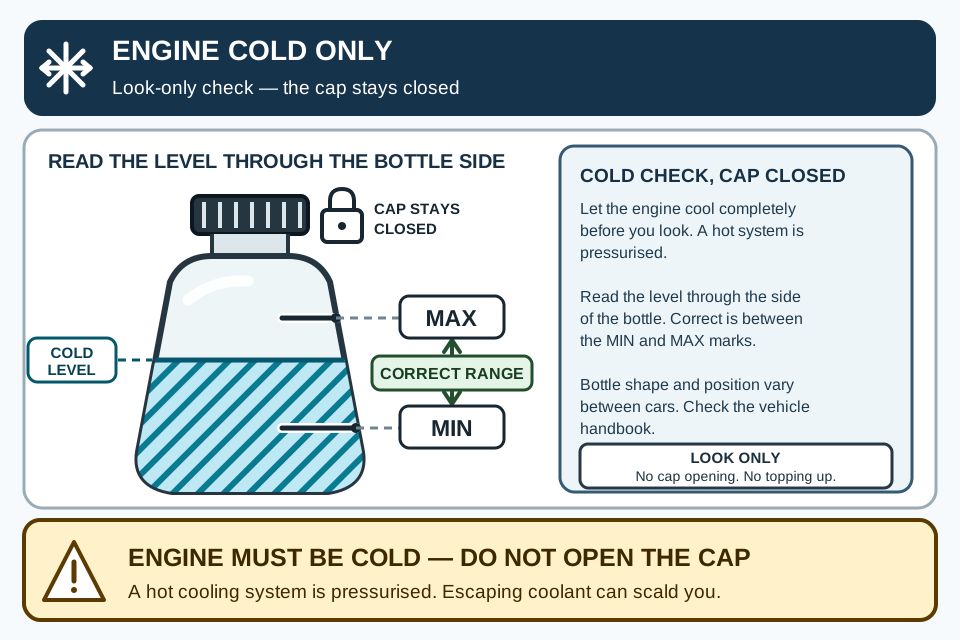
- Look at the cold level through the closed bottle (Green observation)
Only after the car is safely parked, the engine is switched off and the whole system is fully cold, view the translucent expansion bottle from outside. Keep the cap closed. Note whether the visible level is below MIN, between MIN and MAX, above MAX, or impossible to see.
What it means: A level between MIN and MAX answers only the quantity visible in the bottle. It does not show that coolant is circulating, that the fan works, or that the engine is safe to restart.
ungraded — treat as general guidance
Stop if: The engine is not fully cold, there is steam or residual heat, the bottle is opaque, or reading the marks would require opening the cap, touching a hose or reaching near a fan.
Level visible between MIN and MAX → keep the cap closed and report the reading to the recovery service or garage.
Level low, high or not visible → keep the cap closed; do not top up as a test or restart. Report what you can see and recover the car.
- Look for external traces without touching anything (Green observation)
When the engine bay is fully cold, the car is secure and the key is away from the vehicle, stand at the open bonnet and look from above for a fresh puddle, dampness or dried white staining. Do not go underneath and do not squeeze hoses, disturb connectors or reach into the fan area.
What it means: Visible staining or dampness is useful handover evidence, but its location may not be the source. No visible trace does not rule out a leak that appears only under pressure or a circulation fault.
ungraded — treat as general guidance
Stop if: Anything is still hot, access would put you near moving traffic, or seeing more would require touching components, removing a cover or going under the car.
A trace is visible → photograph it from a safe position and show the garage; do not attempt a repair.
Nothing is visible → report that honestly. It does not make the vehicle safe to restart or drive.
- Record what happened before the engine was switched off (Amber observation)
After the vehicle is safely stopped and fully cool, write down whether the warning appeared in traffic or at road speed, what the gauge or message showed, whether there was steam or visible coolant discharge, and whether cabin heat, power or engine sound changed. Use only what already happened; do not restart to reproduce it.
What it means: The pattern helps a garage choose a test path. It cannot confirm a fan, thermostat, pump, blockage or internal engine fault on its own.
ungraded — treat as general guidance
Stop if: You would need to restart, idle or drive the vehicle to answer a question.
A clear pattern is recorded → give it to recovery and the garage with any dashboard photograph.
The pattern is uncertain → say so; uncertainty is not permission to restart or drive.
UK cost
We don’t have a verified UK price range for this job yet. We don’t have a verified UK price range for this symptom yet.
What to give the garage
- Number plate and vehicle details
- Exact temperature warning, message or gauge position
- Whether it happened in traffic, at road speed or both
- Whether there was steam, coolant discharge, loss of cabin heat, loss of power or abnormal noise
- Cold closed-bottle level: below MIN, between MIN and MAX, above MAX or not visible
- Any external staining or dampness seen from above after full cool-down
- Any recent cooling-system work or earlier overheating event
- Any dashboard photograph or stored code already available — do not restart or clear anything to obtain one
Related pages
- P0217 — An engine-coolant over-temperature code follows the same do-not-drive and recovery decision; a code is not a failed-part diagnosis.
- coolant keeps disappearing no leak — Use only after the engine is cold if the visible level is repeatedly falling; active overheating still means recovery.
- car diagnostic test cost — What to ask a garage to include in diagnosis; do not drive the overheating car there.
Related diagnostic context
These pages share a reviewed component or failure mechanism. The connection is conditional, not a diagnosis of this vehicle.
Conditional mechanism chain. Coolant loss can reduce the cooling system's ability to carry heat. If engine coolant actually exceeds its temperature threshold, the ECU can store P0217; the guide covers the same over-temperature stop-and-recovery state even when coolant remains visible.
Only when: Do not infer P0217 or active overheating from a historic coolant-leak advisory. Show the code context only when P0217, a high-temperature warning, a hot-zone gauge reading or steam is actually present; otherwise link only to the guide's cold-observation boundary.
Sources
- The Highway Code — Breakdowns and incidents, rules 275–278 · grade A · accessed · supports place of relative safety, motorway breakdown action, recovery
- RAC Drive — What should I do if my car is overheating? · grade B · published · accessed · supports stop engine, never open hot cap, full coolant requires professional attention, possible cooling faults
- The AA — How to check your engine coolant and top it up · grade B · accessed · supports cold closed bottle observation, min max marks, fan thermostat pump or blockage paths, garage escalation
General guidance, not professional advice.