Flashing engine management light and juddering: stop and recover
Last reviewed · OBDCode UK editorial
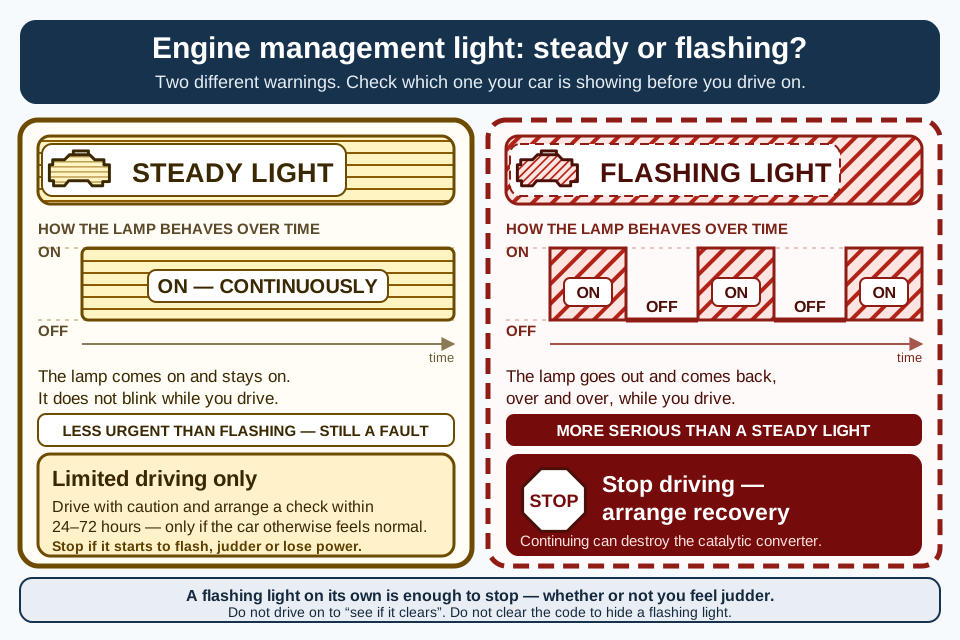
UK cars where the engine management light flashes while the engine is running and the engine judders, shakes, runs unevenly or loses power.
Use another route when
- A steady engine management light with otherwise normal driving — use the steady-or-flashing engine management light guide.
- A brief lamp check only when the ignition is switched on, with no flashing while the engine runs.
- Judder only while braking, steering or at road speed with no engine-running change — use the general juddering guide.
- A red oil-pressure or temperature warning, visible fire, or smoke entering the cabin — follow that emergency warning as well as stopping.
Can you keep driving?
Do not drive — stop and arrange recovery. Do not continue a normal journey or drive to a garage. Reduce load only while moving to the nearest place of relative safety, then switch the engine off and arrange breakdown recovery. The fact that the lamp stops flashing after you stop does not make the car safe to drive.
Concentrate on the road, signal and move out of moving traffic if you can. Use hazard warning lights if the stopped vehicle is an obstruction. On a motorway or other high-speed road, follow Highway Code rules for reaching relative safety and getting help; do not attempt a roadside repair.
Stop and escalate when
- You cannot reach a place of relative safety, are stopped in a live motorway lane, or cannot leave the vehicle safely — use the SOS facility or call 999 and follow instructions.
- There is smoke, fire, a strong fuel smell, a red oil-pressure or temperature warning, or a new loud mechanical noise.
- Power falls sharply, the engine stalls, or the judder is severe — leave the engine off and tell the recovery operator.
- Exhaust fumes enter the cabin or an occupant becomes unwell — get everyone into fresh air when it is safe and seek urgent help.
What the symptom may mean
These are decision branches, not a diagnosis or a UK frequency ranking.
- An active misfire warning — strongly matches this symptom. A flashing engine management light together with engine judder is treated as an active misfire warning. Continued engine operation can overheat and damage exhaust after-treatment components. The lamp does not identify the failed part.
Next evidence: Stop and recover the vehicle. The garage should preserve the fault record and test the cause rather than choose a part from the lamp alone.ungraded — treat as general guidance
- An intermittent event that has paused — remains possible when the flashing stops. The warning may stop when load changes or the engine is switched off. That only says the condition is not being detected at that moment; it does not show that the underlying fault has repaired itself.
Next evidence: Keep the engine off, arrange recovery and give the garage the circumstances and any stored data. Do not recreate the event on the road.ungraded — treat as general guidance
- A second warning or hazard alongside the misfire — can increase the urgency. A red oil-pressure or temperature warning, smoke, fuel or exhaust smell, stalling, or a sharp loss of power is a separate stop signal. It must not be explained away as part of the engine light.
Next evidence: Tell the recovery operator exactly what you observed. Use emergency help if the vehicle or occupants remain at immediate risk.ungraded — treat as general guidance
Observation-level checks
- Record the warning you already saw (Red observation)
Do not prolong the journey to check it. Once stopped safely with the engine off, write down whether the lamp repeatedly flashed after the engine had started and whether the car juddered, ran unevenly or lost power.
What it means: Flashing while the engine runs plus judder matches our stop-driving branch. A normal ignition-on lamp check does not, but do not restart the engine simply to compare them.
ungraded — treat as general guidance
Stop if: The engine is still running, the vehicle is exposed to moving traffic, or you would need to restart or rev it to reproduce the symptom.
Flashing and judder occurred together → leave the engine off and arrange recovery.
You are unsure what the lamp did → do not restart to test; describe the uncertainty to the recovery operator.
- Note other warnings without opening or dismantling anything (Red observation)
From a safe position with the engine off, record any oil-pressure or temperature warning, reduced-power message, stalling, smoke, smell or unusual noise that was already present. Do not touch hot parts, open caps or investigate beside fast traffic.
What it means: These observations help recovery and garage staff choose the safe next action. They do not identify a component and the absence of another warning does not cancel the Stop decision.
ungraded — treat as general guidance
Stop if: There is fire or smoke, a strong fuel smell, exhaust fumes affect occupants, or you cannot make the observation away from moving traffic.
Another hazard was present → report it before recovery is dispatched so the operator can assess the response.
No other warning was seen → recovery is still required for the flashing-lamp-and-judder event.
- Optionally save stored codes with the engine off (Green observation)
Only after the car is safely parked outdoors and recovery is arranged, use a compatible reader you already have if it can save stored and pending codes with the engine off. Save the complete codes and freeze-frame if available. Do not clear anything, start the engine, unplug components or order parts.
What it means: A P0300-family record can help the garage locate where the computer detected misfire, but a code is not proof that a named part has failed. No code or an unreadable scan does not make driving safe.
ungraded — treat as general guidance
Stop if: The reader asks for the engine to be started, socket access is uncertain, the vehicle is not safely parked, or any trim or component would need removing.
Codes saved → give the unedited record to the garage.
No safe static read is possible → skip it; recovery and professional diagnosis remain the next step.
MOT relevance
Where the engine MIL is part of the test, a lamp indicating a malfunction is a Major MOT defect.
DVSA checks that an applicable engine malfunction indicator lamp illuminates and then goes out. If it is inoperative or indicates a malfunction, the defect is Major. An MOT appointment is not a reason to drive a car that has shown a flashing lamp with judder; recover it for diagnosis first.
Source: DVSA MOT inspection manual, section 8 — engine malfunction indicator lamp · grade A
Whether the MIL is inspected depends on vehicle and first-use criteria in the current DVSA manual.
UK cost
We don’t have a verified UK price range for this job yet. We don’t have a verified UK price range for recovery, diagnosis or repair of this symptom yet. The underlying fault and recovery circumstances are not known from the lamp.
What to give the garage
- Registration number and exact vehicle/engine if known
- Whether the lamp flashed continuously or intermittently, and whether it later became steady
- When the judder began: idle, acceleration, hill or another condition
- Any power loss, stall, smoke, smell, unusual noise or other warning lamp
- Stored and pending codes plus freeze-frame if captured safely — do not clear them
- Where the vehicle is stopped and whether occupants are safely away from moving traffic
Related pages
- P0300 — Use the stored-code page only after stopping; it does not authorise driving or a parts swap.
- P0301 — An example of a cylinder-specific misfire record; the code still does not prove which part failed.
- engine management light — Use this decision hub to distinguish a steady lamp from the Red flashing-lamp branch.
- car juddering or shaking — Use only for non-engine judder routes; flashing EML plus judder remains Stop.
- exhaust smell inside car — Cabin fumes add an occupant-safety hazard and need their own escalation.
- car diagnostic test cost — Questions to ask about diagnosis after the vehicle has been recovered.
Sources
- The AA — Red light spells disaster · grade B · published · accessed · secondary public · supports flashing eml misfire, switch off, catalyst and dpf damage risk
- The Highway Code — breakdowns and incidents, rules 275 to 287 · grade A · accessed · supports place of relative safety, hazard warning lights, motorway breakdown and recovery
- DVSA MOT inspection manual — 8. Nuisance, engine malfunction indicator lamp · grade A · accessed · supports mot, engine mil major defect
- NHS — Carbon monoxide poisoning · grade A · accessed · supports fresh air, symptoms, urgent medical help
General guidance, not professional advice.