Noise from under the car: scrape, clunk, rattle or hiss?
Last reviewed · OBDCode UK editorial
UK petrol, diesel, hybrid and electric cars when a new sound seems to come from beneath the vehicle, whether at idle, over bumps, while steering or braking, or as road or engine speed changes.
Use another route when
- A sound clearly inside the cabin or luggage area after a loose item has been identified and secured — this guide cannot prove that a second underbody fault is absent.
- Collision damage, smoke, fire, a visibly damaged tyre, a wheel that is not running true, or changed steering or braking — stop and arrange recovery.
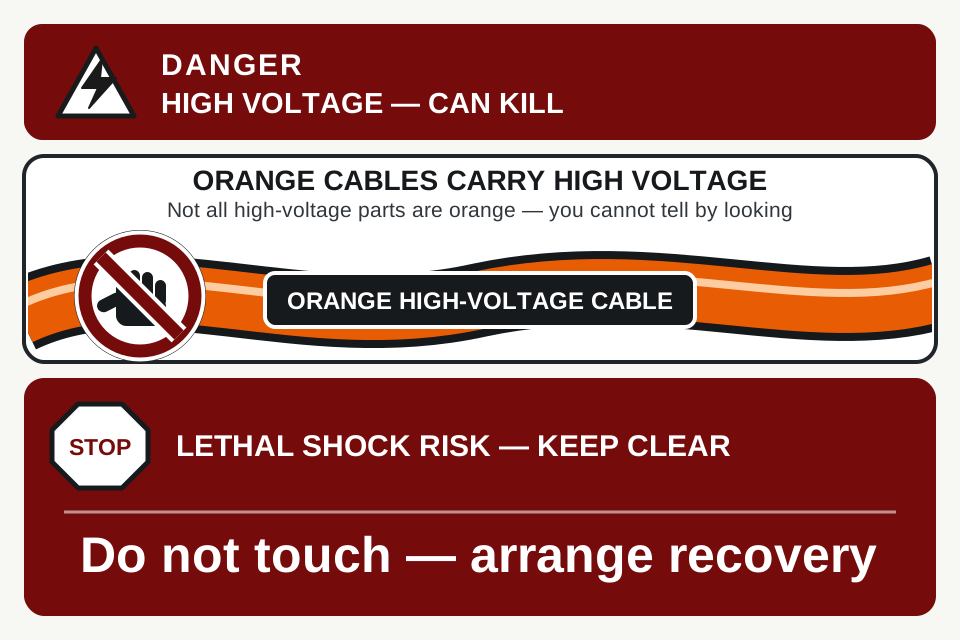
- A visible orange high-voltage cable or damaged traction-battery casing — keep clear, do not touch it and arrange specialist recovery.
Can you keep driving?
Drive only if every stop condition is absent. A mild, intermittent noise with normal steering, braking, tyres and warning lamps may allow one short, slow trip to a nearby garage. Avoid high speed, heavy loads and a normal journey. A continuous scrape, a heavy repeated knock, a hanging part, an active leak or fuel smell, cabin fumes, or a change at the wheel, brakes or steering means stop and recover the car.
If the noise begins while moving, do not investigate or record it yourself while driving. Ease off, avoid harsh steering or braking, and stop in a place of relative safety. Switch off and use recovery if any stop condition is present.
Stop and escalate when
- Any undertray, exhaust, shield, cable or other part is hanging, dragging, loose enough to detach, or scraping continuously
- There is a petrol, diesel or gas smell, visible fuel, liquid actively dripping or reaching a tyre, brake or the road, smoke or a fire risk
- A tyre is damaged or rubbing, a wheel wobbles, or braking, the brake pedal or steering has changed
- Exhaust fumes enter the cabin, the exhaust suddenly becomes much louder, or an occupant feels unwell
- A strong hiss comes with escaping vapour or liquid, overheating, a warning lamp, loss of power or a damaged orange cable
- Never go beneath a vehicle supported only by a jack. This guide does not authorise under-vehicle work.
- Exhaust gases can contain carbon monoxide. Stay in open air and never run the engine in an enclosed space.
- Switch the vehicle off before visual checks. Do not touch exposed conductors or orange high-voltage components.
What the symptom may mean
These are decision branches, not a diagnosis or a UK frequency ranking.
- Scraping or rubbing — may indicate contact rather than a particular failed part. A loose undertray or shield, an exhaust section, debris, or something near a wheel can all produce a scrape. A sound once after a bump and a scrape repeated with each wheel turn are different clues, but neither identifies the component.
Next evidence: Stop and recover for continuous scraping, wheel contact or anything hanging. Otherwise describe the road input and rhythm to a garage that can inspect the vehicle safely on suitable equipment.ungraded — treat as general guidance
- Clunking or knocking — can come from several moving or mounted items. Loose luggage, an exhaust or underbody mounting, suspension or steering movement, or a drivetrain mounting can sound similar from the driver's seat. Whether it occurs over bumps, during braking or steering, or when drive takes up is more useful than guessing a part.
Next evidence: Secure accessible cabin and boot items while parked. Any remaining clunk needs garage inspection; recover the car if direction, steering or braking changes or the knock becomes heavy and repeated.ungraded — treat as general guidance
- Metallic or plastic rattling — may be consistent with a loose item, shield, trim or mounting. A heat shield, undertray, exhaust mounting, loose tool or luggage item can rattle in overlapping ways. A rattle at idle, over rough roads, or only at one engine speed is useful context but is not a parts diagnosis.
Next evidence: Do not touch a hot exhaust or reach under the vehicle. Remove only loose items that are accessible from inside the cabin or boot; leave underbody confirmation to a garage.ungraded — treat as general guidance
- Hissing or escaping-air sound — needs context before it can be interpreted. A hiss may involve air, exhaust gas, vapour or fluid under pressure, while some vehicles also make brief normal pressure-equalising sounds after shutdown. Duration, smell, visible vapour or liquid, warnings and temperature matter; the sound alone does not identify a system.
Next evidence: Do not search for the source with hands, a flame or a running engine. Fuel smell, visible leakage, steam, overheating, cabin fumes or a strong persistent hiss requires recovery.ungraded — treat as general guidance
- Booming, blowing or suddenly louder exhaust noise — may indicate an exhaust leak or insecure section. A change in exhaust note can come from a leak, joint, silencer, shield or mounting, but sound from the cabin cannot locate it or prove which part needs replacement.
Next evidence: Switch off and keep the vehicle in open air. Cabin fumes, a hanging exhaust or a sudden severe noise means recovery; otherwise arrange prompt garage inspection before normal use.ungraded — treat as general guidance
Observation-level checks
- Record when the sound happened (Green observation)
Once safely parked away from traffic, switch off and write down whether the sound was scraping, clunking, rattling, hissing, booming or blowing. Note whether it followed an impact, and whether it changed with bumps, road speed, engine speed, braking, steering, pulling away or reversing. Use only what already happened; do not drive to reproduce it.
What it means: Context helps a garage choose where to inspect. It does not confirm an exhaust, suspension, wheel, brake, steering or drivetrain fault.
ungraded — treat as general guidance
Stop if: Answering a question would require another drive, repeated braking or steering, idling the engine, or standing near moving traffic.
A repeatable context is already known → include it in the garage handover without recreating the noise.
The context is uncertain → say so; uncertainty is not a reason to test-drive the car.
- Check accessible loose items inside the car (Green observation)
With the car switched off, secure visible loose items in the cabin and boot. If the spare-wheel well or tool tray opens normally from above without tools, check that its contents are seated. Do not remove fixed trim or reach through gaps towards the underside.
What it means: Finding a loose item can explain one rattle or clunk. It does not prove that there is no separate fault beneath the car.
ungraded — treat as general guidance
Stop if: Access needs tools, trim removal, lifting a heavy assembly, reaching beneath the vehicle or approaching a damaged battery.
A loose item is found → secure it, but still use recovery if any external stop condition remains.
Nothing is loose inside → do not start shaking, lifting or striking underbody parts to continue the search.
- Look only from around the vehicle (Green observation)
After the car is secure, switched off and cool, walk around it in good light. From outside its footprint, look for a hanging edge, an exhaust section lower than usual, a damaged or rubbing tyre, an active drip or a fresh puddle. Do not put your head, hand or any other part of your body beneath the car, even if it is on its own jack.
What it means: A visible problem is enough to escalate, but its exact source still needs professional inspection. Seeing nothing from the perimeter does not clear hidden brakes, steering, suspension, exhaust, fuel, battery or drivetrain parts.
ungraded — treat as general guidance
Stop if: Anything is hanging, liquid is actively dripping or has reached a tyre, brake or the road, there is fuel smell, smoke, vapour, heat, a damaged tyre, or an orange high-voltage cable or battery casing is visible.
A hanging part, active leak, damaged tyre or orange cable is visible → keep clear, do not start the vehicle and arrange recovery.
Nothing is visible → use the recorded sound and context for a garage; do not crawl under for a better view.
- Record warnings and any change in control (Green observation)
With the vehicle stationary and switched off, photograph any warning message already displayed and write down whether steering, braking, the brake pedal, gear selection, ride height or a wheel felt different before you stopped. Do not restart, press controls repeatedly or turn the steering to provoke the noise.
What it means: A warning or control change raises the urgency but still does not diagnose the noisy component.
ungraded — treat as general guidance
Stop if: There was any steering or braking change, wheel wobble or rubbing, a red warning, overheating, loss of power, or the vehicle no longer sits normally.
Any control, wheel or warning change occurred → do not drive; give the record to recovery and the garage.
No change was noticed → this supports only the limited-driving branch if every other stop condition is also absent.
MOT relevance
The sound itself has no MOT category; the physical defect and its severity determine the result.
DVSA treats an exhaust system that has a major leak or is insecure as a Major defect. Exhaust fumes that endanger occupants, a fuel leak that creates a fire risk, or a body component likely to detach can be Dangerous. Steering, suspension, wheel and brake defects are assessed under their own sections. A quiet car is not proof that these systems are sound, and a noise cannot identify the MOT outcome by itself.
Source: DVSA MOT inspection manual, sections 1, 2, 5 and 6 · grade A
MOT wording describes the defect found during inspection, not the driver's description of a scrape, clunk, rattle, hiss or exhaust noise.
UK cost
We don’t have a verified UK price range for this job yet. We don’t have a verified UK price range for an unidentified under-car noise. Scraping, clunking, rattling, hissing and exhaust noise can lead to very different inspections and repairs.
What to give the garage
- Number plate, make, model and approximate mileage
- Sound type: scrape, clunk, rattle, hiss, boom, blow or another description
- Whether it changed with bumps, road speed, engine speed, braking, steering, pulling away or reversing
- Whether it began after a pothole, kerb, road debris, repair or other impact
- Any warning message and any change in steering, braking, brake pedal, wheel behaviour, ride height, power or gear selection
- Any fuel or exhaust smell, visible fluid, smoke, vapour, heat, hanging part or damaged tyre seen from outside
- Any safe stationary photograph or recording already available — do not drive or run the engine to make one
Related pages
- car clunking over bumps — Use the bump-specific context guide when the sound is a clunk and no stop condition is present.
- exhaust smell inside car — Cabin exhaust fumes override this page to do not drive and arrange recovery.
- wheel bearing replacement cost — Questions to ask only after a garage has identified a wheel-bearing job; noise alone does not prove one.
- car diagnostic test cost — What to ask a garage to include when the source is not yet known.
Sources
- HSE — Working under vehicles · grade A · accessed · supports no access beneath an unsupported vehicle, vehicle support hazard
- The Highway Code — Breakdowns and incidents, rules 275–280 · grade A · accessed · supports place of relative safety, breakdown action, recovery
- DVSA MOT inspection manual — 6. Body, structure and attachments · grade A · accessed · supports exhaust security and leaks, fuel system leaks, components likely to detach, mot
- DVSA MOT inspection manual — 5. Axles, wheels, tyres and suspension · grade A · accessed · supports wheel tyre and suspension defects, mot
- DVSA MOT inspection manual — 2. Steering · grade A · accessed · supports steering defects, mot
- DVSA MOT inspection manual — 1. Brakes · grade A · accessed · supports brake defects, mot
General guidance, not professional advice.