Car turns over but won’t start: safe checks before recovery
Last reviewed · OBDCode UK editorial
UK petrol, diesel and hybrid cars whose combustion engine audibly rotates during a normal start attempt but does not keep running.
Use another route when
- A click, rapid clicking or no engine rotation — use the just-clicks guide instead.
- A fully electric vehicle, an orange high-voltage component or a hybrid-system warning — do not touch high-voltage parts; arrange qualified recovery.
- An engine that stopped after entering deep water — do not make another start attempt.
- LPG, CNG or hydrogen fuel-system faults — keep clear and use a suitably qualified recovery or repair service.
Can you keep driving?
Treat it as a breakdown while it will not start. If it later starts, move it only if needed for safety or go directly for diagnosis, and only with no fuel smell or leak, smoke, flood exposure, battery damage, warning message or abnormal noise; otherwise use recovery.
Switch the ignition off, select Park or neutral, apply the parking brake and stop trying. Use what you already observed; do not crank again merely to collect evidence.
Stop and escalate when
- Strong or increasing fuel smell, visible wet fuel, smoke, heat, a burning smell or flame
- A cracked, swollen or leaking 12V battery, hot cables, hissing or electrical arcing
- The engine stopped after deep water or the cranking sound became abnormally fast, uneven, metallic or clashing
- An orange high-voltage component, hybrid-system warning or damaged high-voltage area
- The vehicle is exposed to moving traffic or cannot be made safe where it stopped
- The engine starts but cuts out again, warning lamps stay on or normal steering or braking is uncertain
What the symptom may mean
These are decision branches, not a diagnosis or a UK frequency ranking.
- Cranking quality or 12V supply is not adequate — can still be involved. Hearing the engine turn does not prove that it is turning normally or that control units retain a stable supply. A slowing or uneven crank, dimming, display resets or multiple electrical messages are useful clues, not a battery diagnosis.
Next evidence: Report the observed sound and display behaviour. A technician can test the battery, supply and starter circuit without using repeated start attempts as the test.ungraded — treat as general guidance
- Fuel is unavailable, inhibited or present in excess — is one decision branch. An empty tank, misfuelling, a control fault or excess petrol after a short cold run can all end in a crank-no-start. A petrol smell cannot safely distinguish harmless flooding from a leak.
Next evidence: Keep the system closed. Give the history to recovery or a garage for safe fuel-quality and pressure testing; do not prime a suspected leak or open diesel high-pressure parts.ungraded — treat as general guidance
- An ignition, engine-position or control signal is missing — may explain the symptom. Petrol ignition, diesel cold-start control, crank or cam position input and related wiring are different routes to the same symptom. No single part can be selected from the sound alone.
Next evidence: Save codes and freeze-frame without clearing them. Leave spark testing, wiring probing, timing checks and parts replacement to the evidence-led garage route.ungraded — treat as general guidance
- The key or start-authorisation system is withholding operation — is possible when the display agrees. A key, immobiliser or security message can identify a separate electronic route. The absence of a message does not rule it out, and repeated key cycling does not repair it.
Next evidence: Photograph the exact message and take all available keys to the technician. Follow only the vehicle handbook for any recognised-key procedure.ungraded — treat as general guidance
- Water entry or a mechanical fault makes further cranking unsafe — must be ruled out by history and sound. A no-start immediately after deep water, or a suddenly fast, uneven, metallic or clashing cranking sound, is not a routine fuel-or-sensor branch. Another attempt could worsen damage.
Next evidence: Do not restart or turn the engine by hand. Arrange recovery and tell the garage about the water depth or abnormal sound.ungraded — treat as general guidance
Observation-level checks
- Classify the attempt you already made (Amber observation)
Do not try again for this check. Write down whether the engine rotated at its usual speed, slowed, sounded uneven, briefly caught, or made a metallic or clashing noise. Save any video already recorded.
What it means: Normal-sounding rotation confirms a crank-no-start route, not a failed part. Slow or changing rotation keeps the 12V supply in scope; impact noise or a sudden change is a recovery condition.
ungraded — treat as general guidance
Stop if: The previous attempt followed deep-water exposure or included a metallic, clashing, suddenly fast or uneven sound.
Usual steady cranking, no stop condition → continue with stationary observations; do not repeat the attempt.
Slow, changing or abnormal cranking → arrange recovery and describe the sound.
- Check for a fuel, fire or battery stop sign (Amber observation)
With the ignition off and in open air, stay outside the vehicle and look from a safe standing position for wet fuel, smoke or battery damage. Notice any strong fuel, burning or sharp chemical smell. Do not switch the ignition on to make a leak appear.
What it means: A strong petrol smell after cranking may be excess fuel or a leak; it is not safe to choose between them by trying again. Visible fuel, smoke or a damaged battery needs recovery.
ungraded — treat as general guidance
Stop if: Fuel is visible, the smell is strong or increasing, smoke or heat appears, a battery is cracked, swollen or leaking, or anything arcs or hisses.
No stop sign → keep the fuel and electrical systems closed and move to the context check.
Any stop sign → keep people away, avoid flames, smoking and electrical switching, and call from a safe distance. Call 999 if there is fire or immediate danger.
- Record what changed before the no-start (Amber observation)
Without opening any system, note the last known fuel level, recent refuelling or possible wrong fuel, a short cold move, deep water, recent repair, a flat 12V battery, long storage and whether the fault is cold-only or hot-only.
What it means: The sequence helps a technician choose a safe test path. It does not prove flooding, fuel-pump failure, a sensor fault or a bad battery.
ungraded — treat as general guidance
Stop if: Wrong fuel is possible, the engine stopped after deep water, or the fault began immediately after work on fuel, timing or high-voltage equipment.
A clear preceding event → include it in the recovery request and do not reverse it with an improvised procedure.
No clear event → that is still useful; do not fill the gap by replacing likely-looking parts.
- Save dashboard and key messages without cranking (Amber observation)
Only after the fuel, fire, battery and flood stop signs are absent, follow the handbook to switch on the dashboard without starting. Photograph the exact key, immobiliser, engine, glow, hybrid or battery message, then switch off.
What it means: An exact message routes diagnosis towards authorisation, engine control or electrical supply. A lamp or symbol is not permission to reset, recode or replace anything.
ungraded — treat as general guidance
Stop if: The display repeatedly resets, the electrical supply weakens, a hybrid warning appears, or switching on produces a fuel smell, smoke, heat or unusual sound.
Message recorded → preserve it and give it to the garage with every available key.
No message → do not assume the immobiliser or engine control is clear; continue only to an optional code read.
- Read and save codes only if conditions are safe (Green observation)
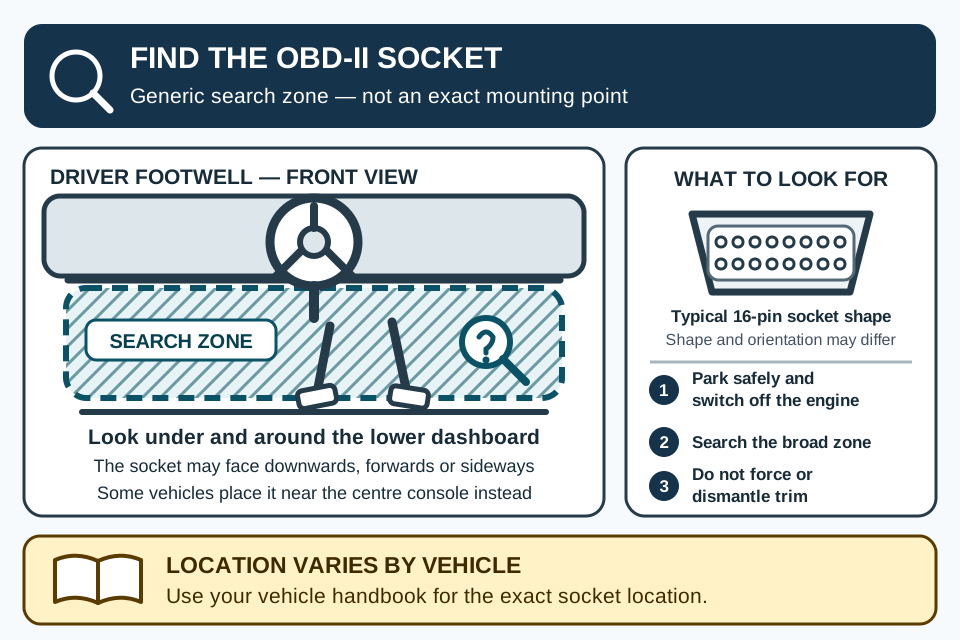
If safely parked and every stop sign above is absent, use a compatible OBD-II reader with the engine off and the ignition mode specified by the handbook. Save all modules and freeze-frame. Do not clear codes, run output tests or crank for live data.
What it means: Codes such as P0335, P0340 or P0562 can identify the next evidence route, but they do not prove that a sensor, battery, key or fuel component has failed.
ungraded — treat as general guidance
Stop if: Socket access needs force or trim removal, the reader asks for repeated cranking, the display weakens, or a fuel, battery, high-voltage or traffic hazard appears.
Codes saved → look up the exact codes and give the unedited record to the technician.
No communication or no useful code → do not clear, probe wiring or start swapping parts; arrange diagnosis.
UK cost
We don’t have a verified UK price range for this job yet. A crank-no-start is a symptom, not one priced repair, and no evidence set in this batch supports a single UK diagnosis or repair range.
What to give the garage
- Number plate, fuel type and exact location of the vehicle
- Whether the engine cranked at its usual speed, slowed, briefly caught or made an abnormal sound
- Exact dashboard messages and photographs
- Any fuel smell, visible leak, smoke, battery damage, heat or electrical symptom
- Recent refuelling or possible wrong fuel, short cold move, deep water, repair, flat battery or long storage
- Every available key and whether central locking behaved normally
- Saved codes and freeze-frame, unedited and not cleared
Related pages
- P0335 — A crankshaft-position circuit route after the code is actually stored; not a sensor diagnosis from the symptom.
- P0340 — A camshaft-position circuit route after a scan; timing and wiring remain possible.
- P0562 — A low-system-voltage route when the code or electrical observations support it.
- Car won’t start and just clicks — Use this when the engine is not actually rotating.
- What a diagnostic quote should include — Use a written, evidence-led scope rather than authorising a part from the symptom.
- 12V battery health checks — Use only after fuel, fire, battery-damage and high-voltage stop signs are absent.
- Car starts but cuts out — A separate recovery route when the engine runs and then stalls.
Frequently asked questions
Should I keep trying if the engine nearly starts?
No. Preserve what you heard and stop repeated attempts. More cranking can flatten the 12V battery, heat the starter and add fuel; arrange diagnosis if one normal attempt has already failed.
Could a strong petrol smell mean the engine is flooded?
It can follow excess fuel after a short cold run, but the same smell can indicate a leak. Switch off, ventilate from a safe distance and do not use a universal pedal or starting-fluid procedure; follow the vehicle handbook or arrange recovery.
Why can the engine turn over if the battery is weak?
Cranking shows that the starter is rotating the engine, but it does not prove normal cranking speed or stable supply to every control unit. Dimming, resets or slowing are clues for a proper battery and supply test, not proof that a new battery is needed.
Can I use starting spray to find out whether fuel is missing?
This guide does not recommend it. It adds a flammable substance and can conflict with intake heaters or vehicle-specific systems. Keep the intake and fuel system closed and let a technician choose a safe test.
Sources
- RAC Drive — Help! My car won’t start, what should I do? · grade B · published · accessed · supports symptom branches, flooded petrol context, avoid extended cranking
- The AA — Top reasons why your car won’t start · grade B · accessed · supports crank no start identity, immobiliser clues, flooded petrol clues, avoid repeated attempts
- The AA — What to do about a strong petrol smell · grade B · accessed · supports fuel smell stop condition, ventilation, professional handoff
- HSE — Introduction to safe motor vehicle repair · grade A · published · accessed · supports petrol fire risk, battery gas and short circuit risk, stationary vehicle safety
- HSE — Fire and explosion in motor vehicle repair · grade A · published · accessed · supports petrol vapour fire boundary, avoid ignition sources, no fuel system work
- RAC Drive — Advice for driving in heavy rain and floods · grade B · published · accessed · supports no restart after deep water, recovery
- The Highway Code — breakdowns and incidents, rules 275 to 287 · grade A · accessed · supports place of relative safety, motorway no repair, recovery
General guidance, not professional advice.