Car won’t start and just clicks: what to do now
Last reviewed · OBDCode UK editorial
UK cars with a conventional 12-volt starting system, plus symptom recognition only for the low-voltage system on a hybrid or electric car.
Use another route when
- The engine turns at normal speed but does not fire — use the turns-over-but-will-not-start guide.
- Motorcycles, 24-volt commercial vehicles and vehicles with a non-standard electrical conversion.
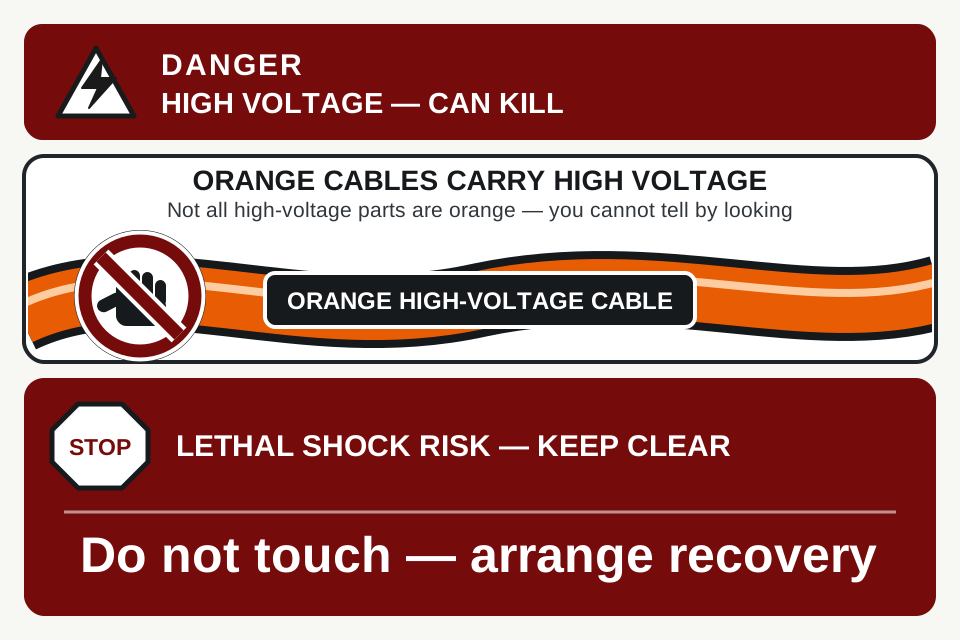
- Any work on orange high-voltage cables, a traction battery, inverter or electric drive system.
- Battery removal, terminal cleaning, voltage testing, jump-lead connection and starter removal — this page is observation-only.
Can you keep driving?
Stay parked and stop repeated attempts. While the car only clicks, it is immobilised: keep it in Park or neutral with the parking brake applied. If it is exposed to moving traffic, prioritise people and follow the Highway Code breakdown route. If safely parked, make observation-only checks and arrange assistance rather than repeatedly operating the starter.
Switch the ignition off. Look and smell for battery damage, smoke, sparks or burning without touching cables or leaning over the battery. Record what happened during the most recent normal start request: rapid clicks, one firm click, engine rotation and what the dashboard did. Do not try again only to collect evidence.
Stop and escalate when
- The vehicle is in a live lane, on a motorway, or anywhere an under-bonnet check would expose you to traffic
- The battery looks swollen, cracked, leaking or badly corroded, or there is smoke, sparking, melted insulation or a burning smell
- A cable smokes or its insulation visibly softens or melts, the sound is a grind or mechanical clash, or the engine compartment shows other damage
- The vehicle is a hybrid or electric car and the handbook’s designated 12-volt assistance points and procedure are unclear
- The car starts with professional assistance but the charging warning stays on, lights dim, electrical systems reset, or the engine stops again
What the symptom may mean
These are decision branches, not a diagnosis or a UK frequency ranking.
- Too little 12-volt power reaches the starter — is consistent with. Rapid repeated clicks, especially with dashboard lamps dimming or resetting, fit a discharged or weak battery or resistance in a battery, cable or earth connection. The click pattern does not distinguish those possibilities.
Next evidence: Ask roadside assistance or a garage to test battery condition under starting load, then check the connections and charging system before recommending a battery.ungraded — treat as general guidance
- The starter circuit engages but does not turn the engine — may indicate. One firm click with no engine rotation can come from the starter motor, solenoid, relay, cable or earth path. A low or weak 12-volt supply still has to be ruled out before a starter is condemned.
Next evidence: A garage should prove the battery supply and high-current cable path, then test the starter circuit. Do not buy a starter from the sound alone.ungraded — treat as general guidance
- The engine is turning, so this is a different no-start — becomes the correct branch when. If the engine rotates repeatedly at its normal starting speed, the starter is cranking it. Fuel, ignition, engine-position or start-authorisation diagnosis belongs on the turns-over-but-will-not-start route, not this clicking guide.
Next evidence: Stop further attempts, preserve warning and fault information, and use the cranks-but-will-not-start guide or a garage.ungraded — treat as general guidance
Observation-level checks
- Decide whether it is safe to check at all (Amber observation)
First locate yourself, passengers and the car relative to moving traffic. On a motorway or high-speed road, do not open the bonnet or attempt a repair; follow the Highway Code’s get-safe and get-help route. At home or in a safe parking place, select Park or neutral, apply the parking brake and switch the ignition off.
What it means: An unsafe location is a recovery decision, not a diagnostic challenge. Moving people away from traffic takes priority over finding the source of a click.
ungraded — treat as general guidance
Stop if: The vehicle is exposed to traffic, you cannot leave it safely, or the car is not securely parked.
Safely parked away from traffic → continue only with the external observations below.
Unsafe roadside or live-lane position → use hazards and seek recovery or emergency help as the Highway Code directs; do not inspect the car.
- Look only for obvious electrical danger (Amber observation)
With the vehicle switched off, look from a normal standing position only if the 12-volt battery or designated assistance area is visible without removing trim. Do not touch, disconnect or tighten anything, do not lean over the battery, and keep clear of orange cables.
What it means: A swollen, cracked or leaking battery, heavy corrosion, melted insulation, smoke, sparks or a burning smell makes jump-starting or further attempts unsafe. A normal appearance does not prove that the battery or cables are sound.
ungraded — treat as general guidance
Stop if: You see damage or leakage, smell burning, hear fizzing, see sparks or smoke, or cannot identify the low-voltage area without approaching orange high-voltage parts.
No visible danger → record the most recent attempt; this is not permission to try again or attach leads.
Any danger or uncertain hybrid/EV access → keep clear and arrange recovery or a qualified technician.
- Classify the most recent start attempt (Amber observation)
Without trying again, recall the most recent normal start request or use a recording already made. Note a rapid series of clicks, one firm click, or the engine actually rotating, and whether dashboard lamps stayed steady, dimmed sharply, flickered or reset. If you did not observe it, leave the detail unknown for the patrol or garage.
What it means: Rapid clicks plus dimming favour the low-available-power branch. One firm click without engine rotation keeps both the supply path and starter circuit in scope. Normal engine rotation means this guide is the wrong branch.
ungraded — treat as general guidance
Stop if: There is grinding, a mechanical clash, smoke, a burning smell, sparking, or any cable or battery area appears to heat or distort.
Rapid clicks or a dashboard reset → request a battery-under-load, connection and charging-system check; do not assume a replacement battery is the answer.
One click with no rotation → request starting-circuit diagnosis. Engine rotates normally → use the cranks-but-will-not-start route. In either case, stop repeated attempts.
- Preserve the context for assistance (Amber observation)
Write down how long the car stood, whether lights or accessories may have been left on, recent battery or charging work, cold-weather exposure, and whether the symptom was sudden or intermittent. If a trained patrol has already used the handbook procedure, record whether assistance changed the click pattern or started the car.
What it means: A successful assisted start shows that extra low-voltage support changed the outcome; it does not by itself prove the battery failed. The charging system, an unwanted electrical load and the cable path may still need testing.
ungraded — treat as general guidance
Stop if: Recording the information would require another start attempt, disconnecting the battery, attaching a charger or opening electrical covers.
The car started with professional assistance → obtain battery, charging and connection results before replacing a part.
It still gives one click, repeatedly clicks, or soon stops again → arrange recovery for a starting-system diagnosis.
UK cost
We don’t have a verified UK price range for this job yet. The click pattern does not identify a job, and no verified UK price range for this symptom was established in this batch.
What to give the garage
- Registration, exact model, year and whether it is petrol, diesel, hybrid or electric
- Rapid clicks, one firm click, no sound, or the engine actually rotating
- Whether dashboard lamps stayed steady, dimmed, flickered or reset
- How long the vehicle stood and whether lights or accessories may have been left on
- Visible damage, leakage, corrosion, smoke, sparks, burning smell or melted insulation
- Battery age if documented, recent battery or charging work, and any charging warning
- What happened during any handbook-compliant assistance performed by a trained patrol
Related pages
- car turns over but wont start — Use this route when the engine rotates normally but does not begin to run.
- car battery health check — Explains what battery evidence a garage should collect without treating one symptom as a battery diagnosis.
- car diagnostic test cost — Questions to ask about the scope of a starting-system diagnosis and written estimate.
- car battery replacement cost — Use only after testing proves that replacement is required.
Frequently asked questions
Why do the dashboard lights work when the car will not start?
Lights and displays can operate while the available 12-volt supply still falls sharply when the starter is requested. That observation keeps the battery and cable path in scope, but it does not prove that the battery itself has failed.
Does a successful jump start prove I need a new battery?
No. It shows that added low-voltage support changed the result. A discharged battery, poor connection, charging fault or unwanted electrical load can still explain it, so ask for test results before authorising replacement.
Should I jump-start a hybrid or electric car from this guide?
No generic jump procedure is given here. Use only the exact 12-volt assistance points and method in that vehicle’s handbook, or call trained recovery. Keep clear of orange cables and traction-battery components.
Sources
- The AA — Top reasons why your car won’t start · grade B · accessed · supports rapid click branch, single click branch, professional diagnosis
- HSE — Using electric storage batteries safely (INDG139) · grade A · accessed · supports battery short circuit, spark and hydrogen hazards, manufacturer jump start instructions
- RAC Drive — How to jump start a car in 10 steps · grade B · published · accessed · supports do not jump damaged battery, owner handbook first, professional help when uncertain
- The Highway Code — Breakdowns and incidents, rules 275 to 287 · grade A · accessed · supports place of relative safety, motorway no repairs, recovery route
General guidance, not professional advice.