Car in limp mode: can you keep driving?
Last reviewed · OBDCode UK editorial
UK cars showing a reduced-power, restricted-performance or limp-mode message, or whose acceleration or gear availability has become clearly capped alongside a warning.
Use another route when
- Gradual hesitation or weak acceleration with no reduced-power message or obvious cap — use the power-loss guide; the symptom alone cannot prove limp mode.
- A red warning, overheating, oil-pressure warning, smoke, severe vibration, changed steering or braking, or power too low for the road — stop and arrange recovery.
- Reset, code-clearing, driving-cycle, forced-regeneration and repair procedures; this page provides observation and garage hand-off only.
Can you keep driving?
Limit driving to the nearest suitable garage. Do not use reduced power to finish a normal journey. One short, gentle trip to a nearby garage is the ceiling only when the vehicle can maintain a safe speed, all warnings are steady amber or absent, temperature is normal, and there is no oil-pressure warning, smoke, severe vibration, stalling or control problem. Avoid any route where limited acceleration would make joining, crossing or clearing traffic unsafe. Otherwise arrange recovery.
Move out of live traffic without demanding more power, stop in a place of relative safety and switch off. Photograph the warnings and leave the vehicle parked if you are already safe. Do not restart or road-test it to see whether full power returns.
Stop and escalate when
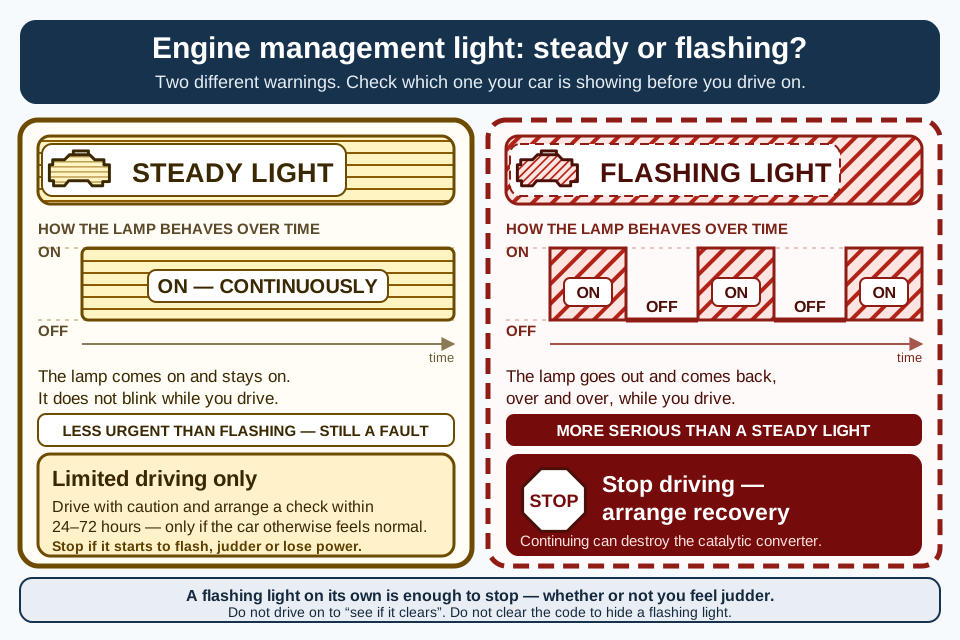
- Any red warning, or an engine management light that flashes
- A rising temperature gauge, temperature warning, overheating, steam or coolant discharge
- An oil-pressure warning, loud knocking or another abnormal mechanical noise
- Smoke, fire, a strong fuel smell, or exhaust fumes entering the cabin
- Severe or worsening vibration, judder, rough running or repeated stalling
- The vehicle cannot maintain a safe speed for the road, or reduced acceleration makes joining, crossing or clearing traffic unsafe
- Steering, braking, gear engagement or another control no longer behaves normally
- Hot components and pressurised fluids can burn you. Let the vehicle cool and never open a hot cooling system.
- Exhaust gases can contain carbon monoxide. Stay in open air and never run the engine in an enclosed space.
What the symptom may mean
These are decision branches, not a diagnosis or a UK frequency ranking.
- A controller may be restricting power or gear availability — is consistent with a reduced-power operating state, not a root-cause diagnosis. When the car explicitly reports reduced performance, a control unit may cap torque, throttle response, engine speed or gear selection after detecting a condition it considers important. The restriction is a protective response; it does not say which component or system caused it.
Next evidence: A garage should preserve the warning and fault record, compare it with the manufacturer's diagnostic information and test the affected system before recommending parts.ungraded — treat as general guidance
- The underlying fault may itself be reducing performance — can feel like limp mode without proving that a controller imposed a limit. Weak acceleration, rough running or poor response can come from the fault rather than a programmed restriction. Without an exact message and diagnostic evidence, “limp mode” is only the driver's description of the behaviour.
Next evidence: Give the garage the exact conditions and warning state. Do not choose a sensor, turbocharger, filter or other part from the symptom alone.ungraded — treat as general guidance
- The transmission may be limiting gear operation — is one possible branch when an automatic stays in one gear or changes abnormally. Restricted gear selection can accompany a transmission-control response, but the same sensation can result from loss of engine power or another driveline problem. The selected gear does not identify a failed part.
Next evidence: Report the displayed gear, warning and conditions to a garage. Recovery is required if the car cannot engage or hold a safe usable gear.ungraded — treat as general guidance
- A separate urgent condition may be present — overrides the generic limp-mode route. A red warning, overheating, oil-pressure warning, smoke, severe vibration, stalling or unsafe road speed is not made safer by a power limit. Treat that observed condition as the decision point and recover the car.
Next evidence: Switch off once safely stopped and tell the recovery operator what was observed. Leave diagnosis to the garage.ungraded — treat as general guidance
Observation-level checks
- Record the exact warning and lamp state (Green observation)
Once safely parked with the vehicle switched off, photograph or write down the exact message, symbol, colour and whether each lamp was steady or flashing. Use the vehicle handbook to identify the symbol. Do not restart the vehicle to recreate the display.
What it means: An explicit reduced-performance message supports the description of limp mode, but it still does not identify the cause. A red warning or flashing engine light moves the decision to do not drive and arrange recovery.
ungraded — treat as general guidance
Stop if: The vehicle is still in live traffic, smoke or fumes are present, anyone feels unwell, or recording the display would require a restart.
Reduced-power message with only steady amber or no lamp → keep the Limited-driving ceiling and arrange prompt garage diagnosis.
Any red or flashing warning, or an uncertain warning you cannot identify safely → leave the vehicle parked and arrange recovery.
- Write down how performance changed (Green observation)
Use only what happened before you stopped. Note the road type, approximate speed, whether acceleration was capped or irregular, whether an automatic held one gear, and whether the car could maintain a safe speed. Do not drive, accelerate or restart to answer any missing detail.
What it means: A repeatable cap can help a technician recognise a reduced-power strategy. Irregular weakness may instead be the fault itself. Neither pattern proves which system or part is responsible.
ungraded — treat as general guidance
Stop if: You would need another journey, a hill, fast traffic, heavy acceleration or a restart to reproduce the behaviour.
The car remained controllable and could maintain a safe speed, with no other stop condition → only the short nearby-garage route may remain available.
Speed, acceleration, gear engagement or control was unsafe or unpredictable → do not drive; arrange recovery.
- Record every recovery trigger already observed (Green observation)
With the vehicle off, record any red or flashing warning, temperature rise, oil-pressure warning, steam, coolant discharge, smoke, strong smell, cabin fumes, severe vibration, stalling, loud mechanical noise or changed steering or braking. Do not open a hot cap, touch hot parts or run the engine to investigate.
What it means: Any listed sign is enough to choose recovery. Seeing none does not diagnose the fault or authorise a normal journey.
ungraded — treat as general guidance
Stop if: There is fire, smoke, leaking fuel, cabin fumes, an unwell occupant, or the vehicle is not in a place of relative safety; move clear and seek emergency help where needed.
No recovery trigger was observed → contact a garage and apply every condition of the Limited-driving route before moving the car.
One or more recovery triggers occurred → keep the vehicle switched off and tell the recovery operator before dispatch.
MOT relevance
Limp mode is not a named MOT defect; the warning or physical fault found by the tester determines the result.
Where an engine malfunction indicator lamp is part of the test, a lamp that indicates a malfunction is a Major defect. Visible smoke and emissions-control defects are assessed separately under the DVSA manual. An MOT appointment does not authorise driving a reduced-power car, and the vehicle should be diagnosed before it is presented.
Source: DVSA MOT inspection manual, section 8 — nuisance and exhaust emissions · grade A
Engine-MIL inspection criteria depend on vehicle type and first-use date. The reduced-power message itself does not identify which MOT item, if any, applies.
UK cost
We don’t have a verified UK price range for this job yet. We don’t have a verified UK price range for diagnosing or repairing an unconfirmed reduced-power symptom. The final cost depends on the fault identified by testing.
What to give the garage
- Registration number, make, model, engine or powertrain and year
- Exact reduced-power message and every warning symbol, colour and steady or flashing state
- What the car was doing when performance changed: road type, speed, acceleration, hill or gear change
- Whether power felt capped or irregular, which gear was displayed and whether a safe speed could be maintained
- Any red warning, temperature rise, oil-pressure warning, smoke, smell, fumes, severe vibration, stall or abnormal noise
- Whether steering, braking or gear engagement changed
- Any stored-code or recovery report already available; do not erase it
- Recent service, repair, battery, engine, gearbox or emissions work
Related pages
- car loses power when accelerating — Use when there is power loss but no explicit reduced-power message or clear cap.
- engine management light — Use the lamp-state hub if an engine management light appears with the power loss.
- engine management light flashing and car juddering — A flashing lamp with judder means do not drive and arrange recovery.
- car diagnostic test cost — Questions to ask about diagnostic scope before authorising work.
Frequently asked questions
Does switching the car off fix limp mode?
No. Performance may appear normal after a later start, but that does not prove the detected condition has gone or the vehicle can be driven. Do not restart or drive it simply to test whether the restriction returns.
Does limp mode tell me which part has failed?
No. It describes restricted operation or how the car feels. A garage needs the exact warning, stored evidence and vehicle-specific tests before it can identify the cause.
Can I drive slowly until the warning clears?
Do not drive to clear the warning. Our verified driving guidance limits this symptom to a short nearby-garage trip only when every safety condition on this page is met. Use recovery for any red or flashing warning, overheating, oil-pressure warning, smoke, severe vibration or unsafe speed.
Sources
- The Highway Code — breakdowns and incidents, rules 275 to 287 · grade A · accessed · supports place of relative safety, high speed road breakdown, recovery
- DVSA MOT inspection manual — 8. Nuisance · grade A · accessed · supports mot, engine mil, visible smoke, emissions control
- RAC Drive — What is limp mode? Symptoms and causes · grade B · published · accessed · secondary public · supports limp mode identity, restricted power and gears, cause not identified by mode, garage diagnosis
General guidance, not professional advice.